


Introducing the Enterprise Readiness Level (ERL), a new standard for corporate-startup collaboration
Over the past decade, open innovation has become a structural practice in large organisations. Corporate venture-client programs, accelerators, innovation challenges, and direct proof-of-concept engagements have proliferated across industries. Yet despite this volume of activity, one number remains stubbornly low: the proportion of startup pilots that convert into real, sustained deployments.
Corporates see thousands of startups. They run dozens of pilots. They deploy very few.
The conventional explanation points to the discovery problem: the difficulty of finding the right innovation among the noise. But discovery, at this point, is largely a solved problem. AI-powered scouting platforms, including Novable, have made it significantly easier to surface relevant solutions at scale. The harder problem, and the one that now concentrates most of the friction in corporate-startup collaboration, is a different one entirely: readiness validation.
Once a promising solution has been identified, how does a corporate innovation team determine whether the company behind it is genuinely equipped to operate as a reliable enterprise partner?
The gap that nobody has filled
This determination is currently made informally, inconsistently, and with significant variation between organisations and even between teams within the same organisation. There is no shared vocabulary. There is no common measurement instrument. There is no accepted standard against which an innovative company can be benchmarked, or against which a corporate can communicate its minimum requirements.
There is, of course, the Technology Readiness Level, the TRL scale, originally developed by NASA and subsequently adopted by the European Commission, NATO, and research institutions worldwide. TRL is excellent at what it was designed to do: assess whether a specific technology works, and how mature its development is. A TRL 7 means something precise and consistent, regardless of who uses the term.
But TRL tells you nothing about the company behind the technology. A startup can have a TRL 8 product and no data processing agreement, no SLA, no enterprise pricing model, no customer success function, and no one on the team who has ever navigated a corporate procurement process. In that situation, the technology is mature. The company is not ready.
This is the structural gap that the Enterprise Readiness Level was built to fill.
What is the ERL?
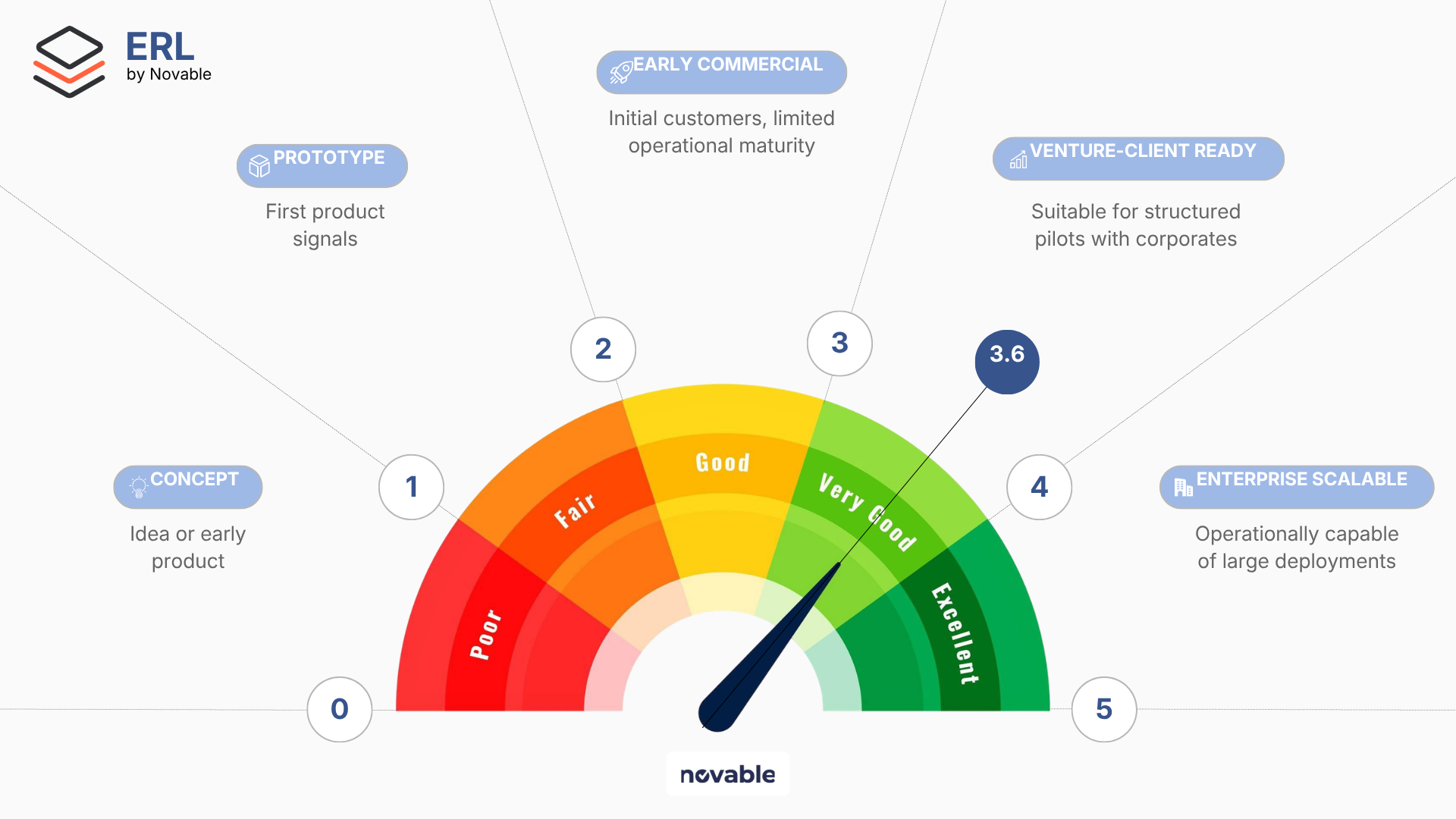
The Enterprise Readiness Level (ERL) is a multi-dimensional maturity framework that assesses whether an innovative company (a startup, scale-up, SME, or research spin-off) is operationally ready to engage productively with a large corporate partner.
It does not replace TRL. It complements it. Where TRL evaluates the technology, ERL evaluates the entity behind it. The two are logically independent: high TRL with low ERL is common, and it is precisely the configuration that generates the most costly failed pilots.
ERL maps assessed companies onto five discrete levels:
ERL 1 - Concept. The company has an articulated value proposition but has not yet demonstrated a deployable product or any commercial traction. Corporate engagement at this stage is exploratory at best.
ERL 2 - Prototype. A working product exists, with initial online signals of product maturity. Operational and compliance infrastructure remains nascent.
ERL 3 - Early Commercial. The company has initial customers and is generating revenue. However, operational maturity (SLA commitments, support infrastructure, compliance certifications) is limited or absent.
ERL 4 - Venture-Client Ready. The company is structurally capable of engaging in a structured pilot with a corporate partner. It demonstrates adequate compliance posture, customer references, product documentation, and operational support capacity.
ERL 5 - Enterprise Scalable. The company is operationally and commercially equipped for large-scale enterprise deployment. It holds relevant certifications, has named enterprise references, offers contractual SLAs, and has demonstrated the capacity to absorb and sustain significant contract volumes.
The six dimensions
ERL scores a company across six weighted dimensions, each reflecting a specific category of enterprise readiness:
Identity (10%) - the baseline verifiability of the entity: legal existence, web presence, contact channels. A company that cannot be confidently identified online cannot be contracted.
Product (20%) - evidence of a deployable, documented, and integrable solution. This includes the existence of product documentation, API references, integration pages, and enterprise pricing tiers.
Technical (15%) - architecture signals relevant to enterprise integration: API-first posture, modern tech stack, authentication standards, and the presence of an application subdomain indicating a live, deployed product.
Security and Compliance (20%) - the dimension that most consistently separates enterprise-ready companies from those that are not. This covers GDPR posture, data processing agreements, SOC2 and ISO27001 certifications, SSO and SAML support, and the existence of a dedicated security page.
Traction (15%) - commercial validation through named customers, enterprise case studies, customer logos, partner ecosystems, and marketplace listings. A company with zero public evidence of customers is a very different risk profile than one with named enterprise references.
Operations (20%) - organisational capacity to support a deployment: a visible customer success function, a support centre, SLA commitments, implementation services, and onboarding or training content.
The weighting reflects a considered view of what actually drives enterprise collaboration failure. Security and compliance gaps, absence of operational support, and lack of verifiable traction are the most common causes of aborted or failed pilots, not insufficient technology maturity.
How the score is computed
ERL is built on observable signals. Rather than relying on self-reported questionnaires (which introduce both response burden and bias) the framework’s first level is designed to be computed primarily from publicly available digital evidence. We are working on additional levels which may include self-reported data and on-site certification (see below).
The current signal catalogue comprises 41 signals across the six dimensions. Each signal is discrete and detectable: does a security page exist? Is SOC2 mentioned? Does the company have named enterprise case studies? Is there a support centre? Does an API documentation domain resolve?
Each signal carries a weight (Low, Medium, High, or Very High) reflecting its informational value for enterprise readiness. Signals are aggregated within each dimension, and dimensions are then combined using their respective weights to produce a composite ERL score, mapped to one of the five levels. An associated confidence score accompanies each estimate, reflecting the proportion of signals that were unambiguously detectable, which is a useful indicator of how complete the assessment is.
This computational approach enables two things that are essential for adoption at scale: speed, and consistency. An ERL Estimate can be generated in seconds from a startup's URL, without requiring any cooperation from the company being assessed. An ERL Assessment layers human expertise on top of the automated score, adding structured evidence review and interpretive commentary. An ERL Certification provides a formal, auditable designation that a company can carry into procurement processes.
How it was built
The ERL framework did not emerge from a theoretical exercise. It was developed iteratively, over several years, through direct observation of what goes wrong in corporate-startup collaboration, and what distinguishes the engagements that succeed.
Novable has worked with over 100 corporate clients across industries and geographies. The pattern that emerged consistently was not a shortage of interesting startups. It was a shortage of startups that were operationally prepared to work with large organisations, and an absence of any structured, shared way to assess that preparedness before committing resources to a pilot.
The signal catalogue was developed through interviews with more than 200 innovation professionals, procurement specialists, and startup operators, combined with analysis of what characteristics distinguished companies that successfully completed corporate pilots from those that did not. The six dimensions and their relative weights reflect this accumulated evidence, not a generic framework applied by analogy.
To bring scientific rigour to the calibration and validation of the framework, Novable has engaged in a research collaboration with UCLouvain, one of Belgium's leading research universities with recognised expertise in innovation management. The academic research agenda covers signal validity, dimensional weight calibration, inter-rater reliability between automated and human-assessed scores, and, most importantly, the predictive validity of the ERL score itself: does a higher ERL at the point of initial engagement predict better collaboration outcomes? The dataset of approximately 50,000 startup profiles accumulated through Novable's scouting platform provides an unusually rich empirical foundation for this work.
The combination of practitioner-derived signals and academic validation is deliberate. A framework that claims to be a standard needs to earn that designation, not through assertion, but through methodological transparency and scientific grounding.

How corporate innovation teams use ERL
For corporate innovation professionals, ERL addresses a problem that is more familiar than it is discussed openly: the difficulty of justifying (internally and externally) why a particular startup was advanced in the collaboration process, or why it was not.
In current practice, these decisions are made on the basis of informal assessments, personal judgment, and criteria that vary between reviewers. ERL provides a common language for these conversations. When an innovation manager can say "this company is ERL 3: the product is commercially proven but the compliance posture is not yet adequate for our procurement requirements," that is a statement that conveys precise, actionable information to legal, procurement, and IT counterparts who may not share an innovation management vocabulary.
Concretely, corporate teams use ERL across several stages of their collaboration workflows. At the screening stage, an ERL Estimate applied to a longlist of candidates allows rapid prioritisation, not by eliminating ERL 2 or ERL 3 companies from consideration, but by calibrating the depth of engagement appropriate to each. An ERL 2 company is an innovation watch, not a pilot candidate. An ERL 4 company is ready to enter a structured engagement process. At the pilot preparation stage, the dimensional breakdown of the ERL Assessment identifies specifically which gaps need to be addressed before a collaboration can proceed, giving both parties a clear, structured roadmap rather than an informal checklist. At the portfolio management stage, ERL scores across a venture-client portfolio or accelerator cohort provide a consistent basis for progress tracking and reporting.
How startups and scale-ups use ERL
The use of ERL by the companies being assessed is, in some respects, the more consequential long-term dynamic.
A startup that understands ERL understands what large organisations are actually evaluating when they consider a collaboration. Not primarily the technology; the technology is a given, the entry ticket. What they are evaluating is whether the company has the operational, commercial, and compliance infrastructure to be a reliable partner. Most startups that have not worked with large organisations before significantly underestimate how important these non-technical dimensions are, and how early in the partnership process they come into play.
ERL gives startups a structured readmap for building enterprise-readiness deliberately. A company at ERL 2 that understands the framework can identify precisely which signals it needs to develop, and in which order, given the weighting, to reach ERL 3 or ERL 4. This might mean prioritising a security page and a GDPR-compliant data processing agreement before investing further in product features. It might mean seeking a named enterprise reference rather than accumulating more SME customers. It might mean establishing a visible customer success function before launching an outbound sales motion targeting large accounts.
There is also a credibility dimension. A startup that can present an ERL Assessment to a corporate partner at the outset of a conversation is communicating something important: that it understands what enterprise collaboration requires, and that it has invested in demonstrating its readiness objectively. In a context where corporate procurement teams are approached by hundreds of startups simultaneously, that signal carries weight.
The structural mismatch ERL is designed to correct
One of the more persistent problems in corporate innovation practice is the uncritical adoption of venture capital evaluation criteria to assess suitability for enterprise collaboration. VC metrics (growth trajectory, market size, fundraising pedigree, disruption potential) are designed for a specific purpose: identifying companies likely to generate exceptional financial returns in a relatively short time horizon. They are not designed to assess operational reliability, compliance posture, or the capacity to support a deployment at scale.
The result is a systematic mismatch. Companies that score exceptionally well on VC metrics may be entirely unsuitable as corporate partners if they lack basic compliance infrastructure, cannot provide contractual SLAs, or have no operational capacity to absorb a large enterprise contract. Conversely, a capital-light company with deep operational maturity and rigorous compliance practices may be an excellent corporate partner, yet systematically undervalued through a VC lens.
Great startups are not the same as enterprise-ready startups. ERL makes that distinction operationalisable.
A standard in the making
The TRL scale became a global standard not because NASA declared it one, but because it was useful, transparent, and widely adopted. It gave communities that had not previously shared a vocabulary (scientists, engineers, programme managers, defence contractors, research funders) a common language for a consequential evaluation.
ERL aspires to the same role for corporate innovation. The ambition is that "What ERL is this startup?" becomes as natural a question in corporate innovation workflows as "What TRL is this technology?" is in engineering and research contexts.
That ambition is realistic, but it requires the same combination of methodological rigour, practical utility, and ecosystem adoption that established TRL. The academic research partnership with UCLouvain is one dimension of this. The progressive adoption of ERL by Novable's corporate clients (who are, for the most part, already using it as part of their startup evaluation and validation workflows) is another. The development of the ERL Estimate as a freely accessible, automated scoring tool is a third, designed to lower the barrier to adoption and generate the usage data needed to calibrate and improve the model over time.
Getting started
If you lead innovation, venture-client, or strategic partnership activity at a large organisation, and you recognise the problem described in this post, the most useful next step is a conversation. We can walk you through how ERL is currently being used by corporate innovation teams, how it integrates with your existing workflows, and what the assessment process looks like in practice.
If you are a startup or scale-up preparing to engage with large enterprise clients, we can show you where you currently stand on the ERL scale and what the most impactful steps would be to strengthen your enterprise-readiness profile.
Laurent Kinet
The Enterprise Readiness Level (ERL) was developed by Novable. A working paper presenting the theoretical foundations of ERL, its scoring methodology, and the proposed research agenda for its scientific validation is available on request.
.png)
.png)